
Oxygen in diving accidents
Why oxygen for every diving accident?
Among divers, oxygen is known as the one essential emergency medication. Diving accident? Give oxygen – you learn that back in OWD, and for good reason. Oxygen is exactly what has been proven to massively improve outcomes.
Outside of diving, oxygen plays a fairly minor role. When emergency medical services carry oxygen, it’s usually because someone doesn’t have enough oxygen in their body. In diving, that’s only sometimes the reason. The really important use of oxygen is decompression sickness – and there oxygen does something completely different: it helps us get nitrogen out of the body.
In short, there are three reasons to give oxygen:
- Lung injuries: provide oxygen because the lungs can no longer take in enough.
- DCS: get rid of nitrogen.
- Unclear situation, but something’s not right: It might help – and it can’t hurt.
Pulmonary overextension injuries
In diving, there are two dive-specific types of accidents. The first is pulmonary overexpansion injuries, i.e., lung barotrauma: pneumothorax, mediastinal or subcutaneous emphysema, and arterial gas embolism (AGE). Parts of the lung are injured, and air can escape in very different places.
This typically happens during or right after surfacing – usually due to ascending too fast, sometimes with a pre-damaged lung that can’t tolerate the ascent. The consequences can be very severe: problems in the lungs, but also in the brain, up to and including loss of consciousness or cardiac arrest. Some presentations look very similar to a stroke.
If parts of the lung are injured or even collapsed, gas exchange is impaired and the body no longer gets enough oxygen. So here it really is about supplying the body with oxygen.
But: Injuries like this don’t go away on their own. Calling emergency services comes first, and CPR if needed. Once that’s underway, give oxygen.

Inhaled water: oxygen supply disrupted
Oxygen can also be important after a drowning incident. If water gets into the airways, gas exchange can be impaired. In this case, it really is about making more oxygen available to the body.
Coughing, shortness of breath, or unusual exhaustion after an incident like this should be medically assessed. If there is shortness of breath or altered consciousness, call emergency services immediately.
Breathing remains the key: Anyone who is breathing adequately on their own can receive oxygen via a suitable mask. Anyone who is not breathing normally needs the appropriate resuscitation measures. An oxygen mask alone does not move air into the lungs.
DCS – decompression sickness
Much more often, we need oxygen for decompression sickness (DCS). Nitrogen bubbles are likely involved, causing problems in different parts of the body. Some evidence suggests that certain supersaturated tissues are linked to certain symptoms. We still don’t fully understand exactly how DCS develops – but we do know very well that oxygen significantly improves many symptoms. So as first aid, it’s definitely useful.
Also important: DCS is a more or less controllable risk, but it can never be eliminated completely. At some point we have to surface, and we always accept a certain degree of supersaturation. DCS can occur even after completely normal dives where nothing went wrong. So if you feel strange after diving, always remember it could be related to the dive.
Mild symptoms
- mild joint pain
- “diver’s fleas”: itchy skin and mild redness
- severe fatigue
Not every bout of fatigue after diving is DCS – diving is strenuous, you’re standing in the sun, and some people react to neoprene. No need to panic. But: skin symptoms can be a precursor to bigger problems, and fatigue can be mistaken for neurological deficits. Anything that shows a progressive trend should be taken really seriously! And don’t let anyone talk you out of it.
Skin DCS (cutis marmorata)
A middle ground is map-like, slightly swollen, and often painful patches of skin – cutis marmorata or livedo racemosa. They used to be considered a mild symptom. We now know they often come with neurological symptoms and can be a precursor to more severe forms. The rule here: give oxygen, definitely call the DAN or aqua med emergency hotline, send photos – and don’t assume it will go away, even if it improves at first with oxygen.
Images and further information:
Hartig F, Reider N, Sojer M, Hammer A, Ploner T, Muth CM, Tilg H, Köhler A. Livedo Racemosa – The Pathophysiology of Decompression-Associated Cutis Marmorata and Right/Left Shunt. Front Physiol. 2020 Sep 3;11:994. doi: 10.3389/fphys.2020.00994.

Severe symptoms
- moderate to severe pain
- coordination problems
- vision and speech problems
- dizziness
- loss of consciousness
The list of possible symptoms is long, and some are easy to confuse with other conditions, such as a stroke. If someone is no longer acting normally, is clearly in pain, is unsteady, or can’t get their suit off anymore: that’s the moment to get oxygen and call for help – not to wait and see if it gets better on its own.
What does oxygen do in DCS?
In DCS, the problem isn’t too little oxygen, but too much nitrogen: bubbles in venous blood and in tissues, plus the nitrogen that’s still in the tissues after the dive and can make the bubbles grow. So we want one thing: to get nitrogen out of the body as quickly as possible.
- If you breathe 100% oxygen, the alveoli contain only oxygen and no nitrogen.
- That makes the pressure gradient for nitrogen between blood and lungs much larger, so nitrogen can be exhaled much faster.
- The blood flowing back into the body carries hardly any nitrogen and can therefore transport more out of all tissues.
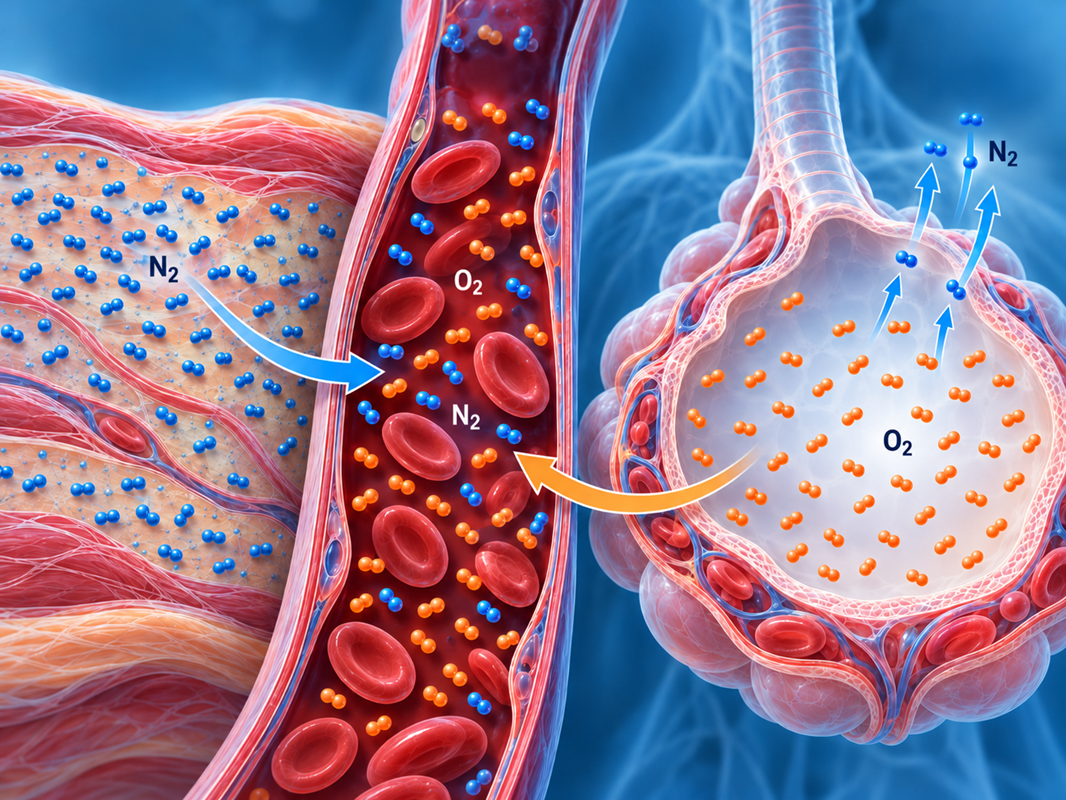
Oxygen against bubbles
And then there’s a bit of magic: around a nitrogen bubble there’s now hardly any nitrogen, but lots of oxygen. Nitrogen moves out of the bubble, oxygen moves in – and the oxygen is used up by the body. In the end, the bubble is smaller and can be exhaled via the lungs. We don’t know for sure whether it works exactly like that in the body. But that oxygen works has been clearly proven.

It’s not about oxygen saturation!
In DCS, blood oxygen saturation is usually good. So the little finger clip often shows nice numbers – and yet the person still needs as much oxygen as possible. First responders who rarely deal with diving accidents sometimes turn the oxygen down when the saturation looks fine. For other emergencies that’s smart; for us it isn’t. Here you can absolutely step in and explain that it’s about nitrogen, not saturation.
As much as possible, for as long as possible – without breaks
What matters is the highest possible concentration, for as long as possible, without interruption. Anyone who takes the mask off every few minutes to drink or talk breathes nitrogen back in and undoes part of the benefit – each time, it takes a while for the gradient to build up again throughout the body.
And if the supply is limited: never lower the concentration to make it last longer! Better shorter at full concentration than longer with little oxygen – or only every third breath. Then it barely helps at all.
Oxygen for diffuse symptoms
DCS can present in very different ways. Mild symptoms like extreme fatigue or slight blotches can develop into severe ones, and bubbles can continue to form for quite some time after the dive.
- If any discomfort could be related to diving, oxygen is the right call to start with.
- Monitor the situation – and call the DAN or aqua med emergency hotline. The hotlines will also help you if the person isn’t insured there, and you’ll get a qualified assessment of whether an ambulance and a recompression chamber are needed.
- If you think it’s serious: call emergency services. Calling once too often won’t hurt.
And don’t forget: other health problems can also occur after diving. Not everything that happens after a dive is caused by diving. So if you give oxygen, keep an eye on what else might be going on with the person.
Observe—without turning it into an exam
While the oxygen is running and help is being arranged, stay with the person. Ask what they’re feeling and since when. Pay attention to whether they answer clearly and whether their condition changes.
A few simple checks can provide additional clues:
-
Orientation: What’s your name? Where are we right now? About what day is it today?
-
Speech: Can the person clearly explain what happened? Does their speech sound different than usual?
-
Hand strength: Have them squeeze your fingers with both hands at the same time. Is one side noticeably weaker? Ask whether this difference existed before.
Write down any abnormalities with the time. New weakness, confusion, or speech problems are reasons to make an emergency call immediately.
Normal answers and equally strong hands do not rule out DCS. These checks must not delay either the emergency call or giving oxygen.
By the way: If you’d like to learn this in more detail, you’ll find additional observations and exercises in our Neuro Check.
What the next responders should know
In an emergency, it quickly gets confusing what happened when. A few notes help:
-
When did the last dive end?
-
Which symptoms occurred when?
-
Since when has the person been receiving oxygen, and via which system?
-
What has improved or worsened since then?
-
Which known conditions or medications could be important?
Have the dive computer and the information on the last dives ready. With the person’s consent, skin changes can be photographed.
Even if the symptoms go away: pass this information on and have the next steps medically clarified. Improvement on oxygen is not an all-clear.

